


In 2023, the iPhone 15 brought a 48MP main camera, Dynamic Island, the A16 Bionic chip and USB-C to Apple's standard iPhone lineup. In 2026, the iPhone 18 Pro takes the same basic iPhone formula much further with an A20 Pro chip, a variable-aperture camera system, more advanced telephoto cameras, a 120Hz ProMotion display, longer battery life and Apple's latest AI features.
So, is the iPhone 18 Pro actually worth upgrading to from an iPhone 15?
The answer depends largely on how much you care about the camera, performance, battery life and newer Apple Intelligence features, and how much of the cost you can recover by selling your current phone.
iPhone 15 vs iPhone 18 Pro: Quick comparison
| Feature | iPhone 15 | iPhone 18 Pro |
|---|---|---|
| Release year | 2023 | 2026 |
| Chip | A16 Bionic | A20 Pro |
| Main camera | 48MP | 48MP variable aperture |
| Ultra Wide | 12MP | 48MP |
| Telephoto | 2x optical-quality | 4x optical, up to 8x optical-quality |
| Front camera | 12MP | 18MP Center Stage |
| Apple Intelligence | No | Yes |
| Port | USB-C | USB-C |
| Pro camera controls | No | Yes |
iPhone 15 vs iPhone 18 Pro: Design and display
The iPhone 15 has a 6.1-inch display, while the iPhone 18 Pro moves up slightly to 6.3 inches. That's a small bump, so this upgrade is not really about getting a much larger screen.
The bigger difference is the refresh rate. The iPhone 15 runs at 60Hz, while the 18 Pro uses a 120Hz ProMotion display. Scrolling, animations and games look noticeably smoother, and it's the kind of change most people notice within minutes.
The iPhone 15 already introduced the Dynamic Island to the standard iPhone lineup, so moving to the iPhone 18 Pro is not the same kind of visual jump as moving from an older notch-based iPhone. The 18 Pro does shrink the Dynamic Island and lets it show up to three Live Activities at once.
Beyond the screen, the 18 Pro is designed as a professional model. Its display, camera controls and overall hardware are built around giving users more control rather than simply providing the standard iPhone experience.
If your iPhone 15 screen still looks good to you and 60Hz has never bothered you, the display alone is not a strong reason to upgrade.
iPhone 15 vs iPhone 18 Pro Performance: A16 Bionic vs A20 Pro
The iPhone 15 uses Apple's A16 Bionic chip, which is still a capable processor for everyday use. It handles social media, streaming, photography, gaming and normal multitasking without making the phone feel old.
The iPhone 18 Pro moves to A20 Pro, a newer chip built around heavier performance and on-device AI workloads. Apple says A20 Pro uses a new 2-nanometer process and includes Neural Accelerators and a redesigned GPU aimed at demanding graphics and AI tasks.
For most buyers, though, don't expect an A20 Pro phone to magically make Instagram open faster.
The difference matters more if you play demanding games, edit video, use professional creative apps or intend to keep the phone for several years. For someone whose iPhone 15 is mainly used for messaging, social media, browsing and photos, performance is not a reason to upgrade.
iPhone 15 vs iPhone 18 Pro Camera: The biggest upgrade
This is where the iPhone 18 Pro makes the strongest case.
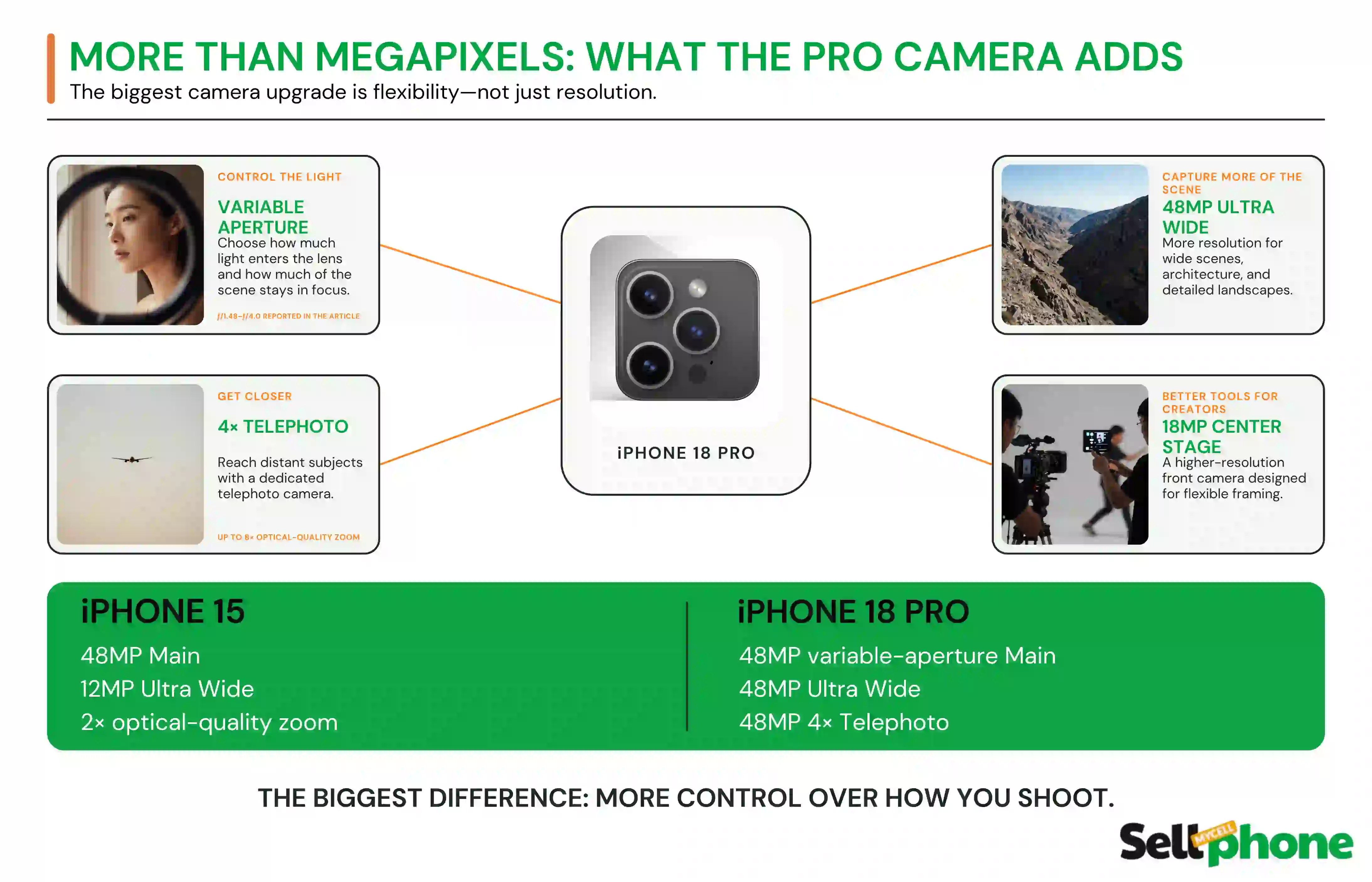
The iPhone 15 has a 48MP Main camera and a 12MP Ultra Wide camera. The 48MP sensor on the iPhone 15 also provides a 2x optical-quality telephoto option.
The iPhone 18 Pro keeps a 48MP Main camera but adds something completely new: variable aperture.
The Main camera can move between four aperture settings, from ƒ/1.48 to ƒ/4.0. In simple terms, the aperture controls how much light enters the lens and how much of the scene appears in focus. A wider aperture can help in low light and create more background separation, while a narrower aperture can keep more of a scene in focus.
That does not mean every photo taken with the 18 Pro will suddenly look dramatically better.
For casual photographers, Apple's automatic adjustments may do most of the work without requiring manual control. The feature becomes more useful when you deliberately want to control depth of field, lighting or the look of a shot.
Video is where these camera changes add up. The iPhone 15 shoots good footage, but you’re working with one main camera and a 2x crop. The 18 Pro gives you a 48MP Ultra Wide, the Main camera and a 4x Telephoto, so you can frame the same scene from very different distances without moving your feet. It records 4K Dolby Vision at up to 60 fps and can shoot 4K slow motion at up to 120 fps on the Main camera, while the iPhone 15’s slow motion tops out at 1080p. Pro shooters also get ProRes recording at up to 4K 60 fps with external storage and Apple Log 2, though most people will never touch those. The variable aperture adds control over how much of the background stays sharp, which can make clips look more deliberate. The 18MP Center Stage front camera helps too if you film yourself or take a lot of video calls. If you shoot family events, travel clips or content for social media, this is the part of the upgrade you’re most likely to notice.
The 18 Pro also upgrades the Ultra Wide camera to 48MP and adds a 48MP 4x Telephoto camera with an 8x optical-quality zoom option. That is a substantial jump in flexibility for people who shoot portraits, distant subjects, travel photos or video.
If the camera is what you care about most, it is the strongest reason to move from the iPhone 15 to the iPhone 18 Pro.
iPhone 15 vs iPhone 18 Pro: Apple Intelligence
The iPhone 15 and iPhone 18 Pro have an important software difference.
Apple Intelligence requires an iPhone 15 Pro or later, so the standard iPhone 15 misses out. The iPhone 18 Pro is supported.
If you do not care about Apple's AI features, this may not be enough to justify an upgrade.
But it becomes more relevant if you are planning to keep your next phone for several years. The 18 Pro gives you access to Apple's AI platform rather than locking you out because of older hardware.
iPhone 15 vs iPhone 18 Pro: Battery life
Battery life is another area where the newer Pro hardware has an advantage.
Apple rates the iPhone 18 Pro for up to 36 hours of video playback on eSIM-only models, compared with up to 20 hours for the iPhone 15. Models with a physical SIM tray are rated slightly lower. These are Apple's own laboratory figures, so real-world battery life will vary with usage, network conditions, battery health and settings.
Still, Apple has made battery endurance a major part of the newer model, which could matter if you regularly spend long days away from a charger.
Price: What the upgrade costs
The iPhone 18 Pro starts at $1,199. For comparison, the iPhone 15 launched at $799.
That's a significant spend, especially if your current phone still does everything you need. The real question is how much of that cost you can recover from the phone you already own.
Who should upgrade and who shouldn't
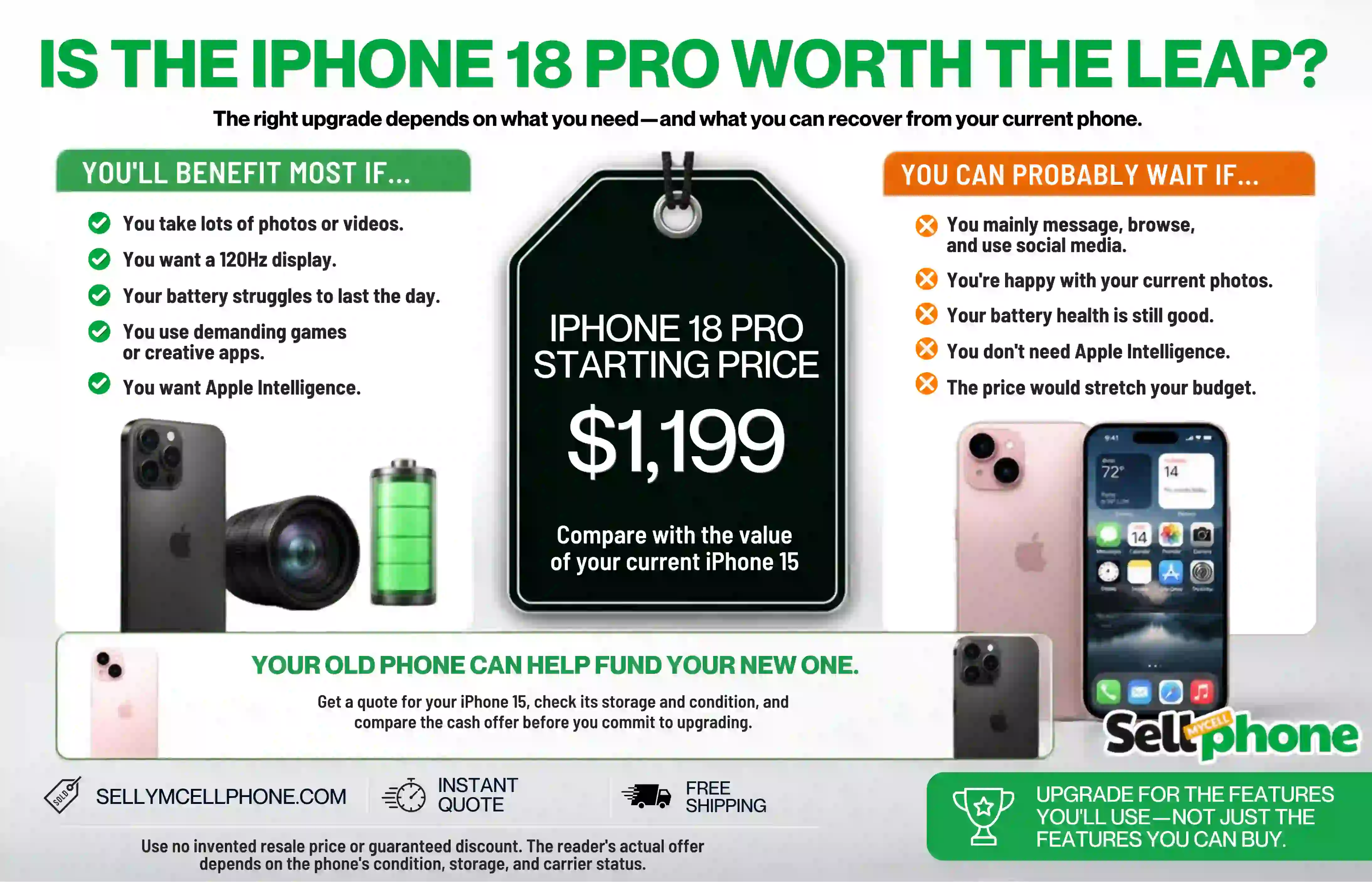
Upgrade to the iPhone 18 Pro if you:
- Take a lot of photos or video: The variable-aperture Main camera, 48MP Ultra Wide and 4x Telephoto give you far more flexibility than the iPhone 15's two-camera setup.
- Want Apple Intelligence: The standard iPhone 15 can't run it, and that won't change with a software update.
- Regularly run out of battery: Up to 36 hours of rated video playback is a big step up from the iPhone 15's 20 hours.
- Play demanding games or edit video: The A20 Pro and 120Hz display make a real difference for heavier workloads.
- Plan to keep your next phone for several years: Newer hardware gives you more room for future iOS features and apps.
Stick with your iPhone 15 if you:
- Mainly use your phone for messaging, browsing and social media: The A16 Bionic still handles everyday tasks comfortably.
- Are happy with your photos: If the iPhone 15's camera already covers what you shoot, the 18 Pro's extra controls may go unused.
- Don't care about AI features: Missing Apple Intelligence won't affect how the phone works day to day.
- Have a tight budget: At $1,199, the 18 Pro is a big expense for a phone that may not change how you use it.
- Still have good battery health: If your iPhone 15 gets through the day without trouble, battery life alone isn't a reason to switch.
Upgrading? Offset the cost by selling your iPhone 15
Your iPhone 15 still has solid resale value. It’s a recent, capable phone with USB-C, which keeps it in demand on the used market.
How much you get depends mainly on storage capacity, condition and whether the phone is carrier-locked or unlocked. A clean, unlocked iPhone 15 with higher storage will fetch noticeably more than a locked model with a cracked screen.
Where you sell matters too. Carrier trade-in offers are convenient, but they often pay less or tie the value to bill credits. SellMyCellPhone pays cash instead, and in a side-by-side comparison against major buyback platforms, it paid about 30% more on average.
Here’s how it works: enter your iPhone 15’s storage, carrier and condition to get a quote in minutes. SellMyCellPhone locks in that price, you ship the phone for free with a prepaid label, and you get paid fast once it’s inspected.
Timing matters as well. Used iPhone values tend to drop as newer models release, so selling sooner usually gets you a better offer. If you’re planning to buy the iPhone 18 Pro, get your iPhone 15 quote first so you know exactly how much of the $1,199 it will cover.
Is the iPhone 18 Pro worth upgrading to from the iPhone 15?
The iPhone 18 Pro is a meaningful upgrade, but not everyone needs it.
If your iPhone 15 still performs well and you mainly use it for everyday tasks, there is no urgent reason to replace it simply because a newer iPhone exists.
The upgrade becomes easier to justify if you want substantially more camera flexibility, a smoother 120Hz display, longer battery life, Apple Intelligence, stronger performance for demanding tasks or a phone designed to last through several more years of new features.
For a casual iPhone 15 user, the upgrade is mostly about getting more capability. For a photographer, creator, gamer or heavy user, the difference is much easier to notice. Either way, selling your iPhone 15 can take a real chunk out of the upgrade cost.
Faqs on iPhone 18 Pro vs iPhone 15
Is the iPhone 18 Pro bigger than the iPhone 15?
Yes, but only slightly. The iPhone 18 Pro has a 6.3-inch display compared with the iPhone 15's 6.1-inch screen. The phone itself measures about 5.91 x 2.83 x 0.34 inches, making it a little taller and thicker than the iPhone 15 at roughly 5.81 x 2.82 x 0.31 inches. In the hand, the difference is noticeable but not dramatic.
Is the iPhone 18 Pro worth it?
It depends on how you use your phone. The iPhone 18 Pro is worth it if you want a much more flexible camera system, a smoother 120Hz display, longer battery life, Apple Intelligence or stronger performance for gaming and video editing. If your iPhone 15 still handles everything you do and you're happy with the camera, there's no urgent reason to spend $1,199 on an upgrade.
Where to sell my iPhone 15 for cash?
You can sell your iPhone 15 for cash at SellMyCellPhone. Enter your model, storage, carrier and condition to get an instant quote, then ship the phone for free using a prepaid label and get paid fast once it's inspected.
SellMyCellPhone also locks in your quoted price and pays cash rather than store credit. In its comparison against major buyback platforms, it paid about 30% more on average.