


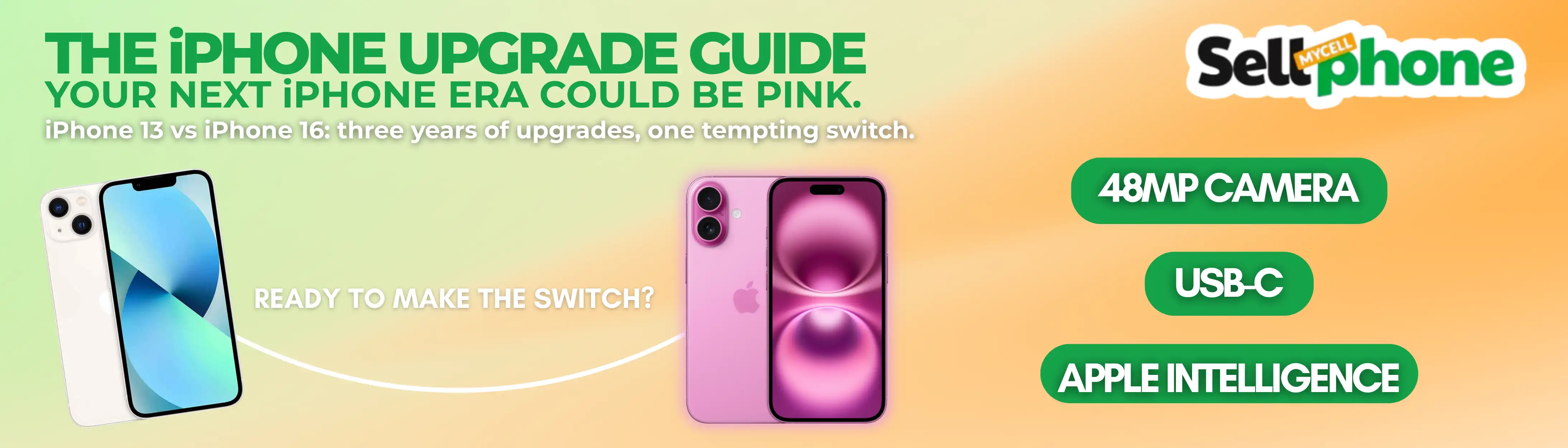
The iPhone 13 is no longer the new kid on the block. It launched in 2021, while the iPhone 16 arrived three years later with a newer chip, a redesigned camera setup, USB-C, and support for Apple Intelligence.
But that does not automatically make the iPhone 13 a bad buy or useless in 2026.
If you're shopping for an iPhone, the real question is whether the iPhone 16's improvements justify paying more. Someone who mainly wants a reliable phone for calls, social media, photos, streaming and everyday apps may reach a different answer than someone who wants newer features and a phone they can keep for years.
If you already own an iPhone 13, the question is whether the upgrade fixes something that actually holds you back, and what to do with your old phone if you make the switch.
Here is how the two compare.
iPhone 13 vs iPhone 16: Quick comparison
| Feature | iPhone 13 | iPhone 16 |
|---|---|---|
| Release year | 2021 | 2024 |
| Chip | A15 Bionic | A18 |
| Display | 6.1-inch OLED | 6.1-inch OLED |
| Storage | 128GB 4GB RAM, 256GB 4GB RAM, 512GB 4GB RAM | 128GB 8GB RAM, 256GB 8GB RAM, 512GB 8GB RAM |
| Main camera | 12MP | 48MP |
| Ultra Wide | 12MP | 12MP |
| Apple Intelligence | No | Yes |
| Charging port | Lightning | USB-C |
| Camera Control | No | Yes |
| Action button | No | Yes |
iPhone 13 vs iPhone 16 Design and display
At first glance, the iPhone 13 and iPhone 16 do not look dramatically different. Both have a 6.1-inch OLED display, so the basic screen experience is still familiar. Both also still run at a 60Hz refresh rate, even though the iPhone 16 arrived three years later.
The bigger changes are around the screen rather than the panel itself. The iPhone 16 has the Dynamic Island, while the iPhone 13 uses the older notch design. The iPhone 16 also has an Action button and Camera Control, giving you quicker access to functions that would otherwise require opening an app or changing settings manually.
The iPhone 13's display is still perfectly usable in 2026. If you mostly watch videos, scroll through social media, read, or use messaging apps, the screen size and OLED quality are not suddenly outdated.
So, this is not the section where the iPhone 16 makes the biggest argument for itself.
iPhone 13 vs iPhone 16 Performance: A15 Bionic vs A18
The iPhone 13 runs on Apple's A15 Bionic chip, which is still capable of handling everyday tasks without much drama. The iPhone 16 moves to the A18 chip, giving it a newer performance platform and more headroom for demanding apps, games and newer software features.
The more important difference is not simply that A18 is newer.
The iPhone 16 was designed with Apple Intelligence in mind, while the iPhone 13 lacks the hardware to run it.
That matters if you intend to keep the phone for years. As Apple's software becomes more dependent on newer hardware for on-device AI features, buying the iPhone 16 gives you access to capabilities the iPhone 13 simply cannot offer.
For basic use, however, the A15 Bionic is still more than enough.
iPhone 16 vs iPhone 13: Camera
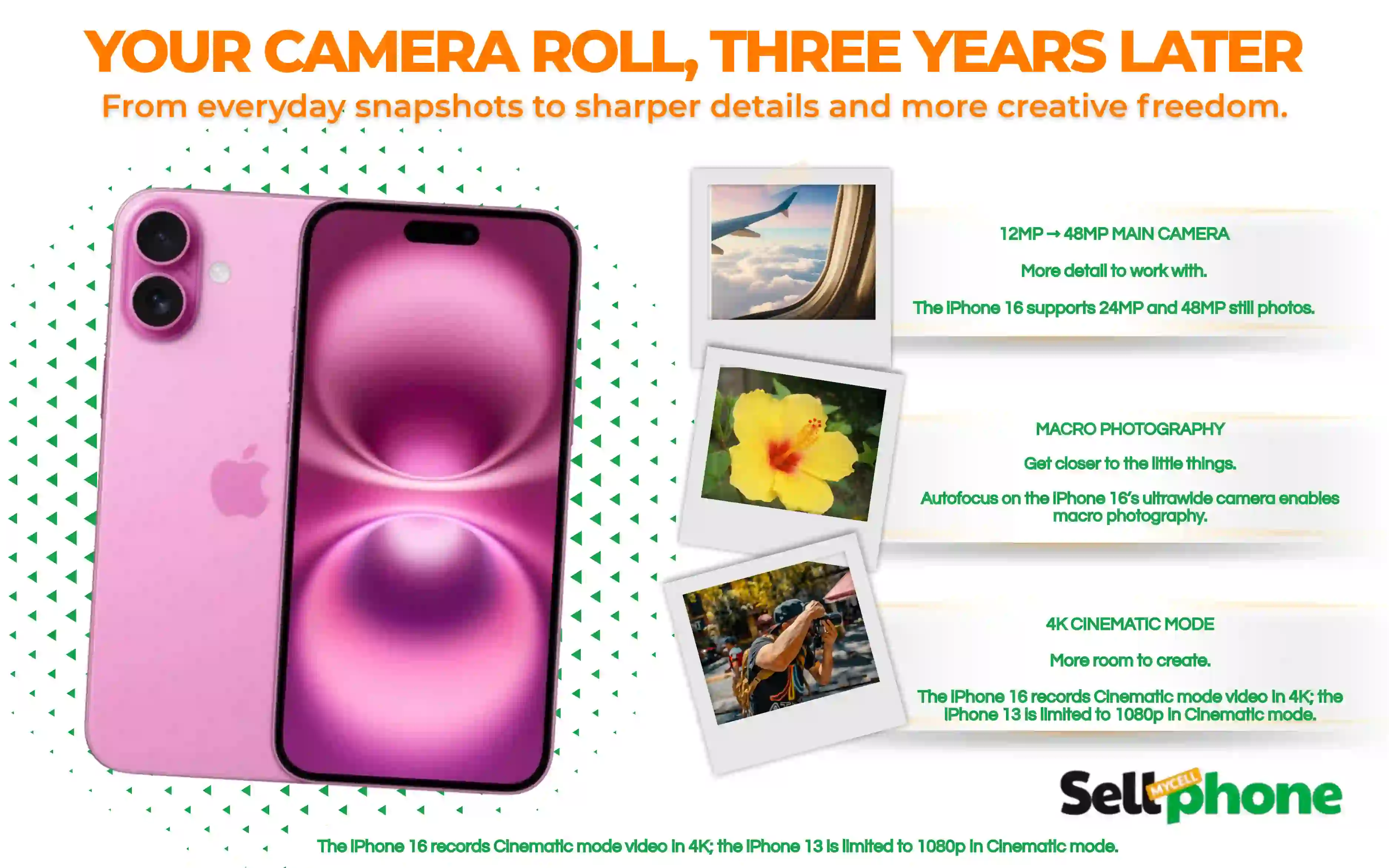
The iPhone 13 has a dual 12MP camera system with a Main and Ultra Wide camera. The iPhone 16 upgrades the Main camera to 48MP and uses it to provide both the main camera experience and a 2x optical-quality telephoto option.
The practical difference is more important than the megapixel count. The iPhone 16 produces 24MP photos by default, capturing more detail and better dynamic range than the iPhone 13's 12MP shots. Its 2x optical-quality zoom is also a good upgrade, since anything past 1x on the iPhone 13 loses quality quickly.
The iPhone 16's Ultra Wide camera adds autofocus, which unlocks macro photography, and its front camera gets autofocus and a brighter aperture for sharper selfies. It can also capture depth automatically in Photo mode, so you can turn regular shots of people and pets into portraits later.
Both phones record 4K video at up to 60fps in Dolby Vision, but the iPhone 16 adds 4K Cinematic mode, Action mode, Audio Mix and spatial video. Camera Control rounds things out with a dedicated button for opening the camera and adjusting settings.
The iPhone 13 can still take good everyday photos. But if photography is one of the main reasons you are buying a newer iPhone, the iPhone 16 gives you considerably more to work with.
iPhone 13 vs iPhone 16: Battery life
Battery life is one of the most practical differences between these two phones, and it matters more the longer you plan to keep one.
On paper, the iPhone 16 lasts longer. Apple rates it for up to 22 hours of video playback, compared to 19 hours on the iPhone 13. That's a few extra hours of screen time on a busy day, which is enough to change how often you reach for a charger.
The bigger issue is age. Those ratings apply to phones with brand-new batteries. Any iPhone 13 you buy or own in 2026 has years of charging cycles behind it, so real-world battery life is likely well below what it was at launch. You can check yours in Settings > Battery > Battery Health & Charging.
The iPhone 16's battery is also built to last longer. Apple says batteries on the iPhone 15 and later retain 80% of their original capacity after 1,000 full charge cycles, double the 500 cycles quoted for the iPhone 14 and earlier. You can also cap charging at 80% or higher to reduce wear over time.
Charging is faster too. Both phones reach 50% in about 30 minutes with a 20W adapter, but wireless charging is where the iPhone 16 pulls ahead. It supports MagSafe and Qi2 charging at up to 25W with a compatible charger and adapter, compared to 15W on the iPhone 13.
If your iPhone 13's battery still gets you through the day, this may not push you to upgrade. But if you're buying a phone to keep for years, the iPhone 16 starts with a longer-lasting battery and holds up better over time.
USB-C vs Lightning
This sounds like a small difference until you have several devices to charge.
The iPhone 13 uses Apple's Lightning connector, while the iPhone 16 uses USB-C. USB-C makes the iPhone 16 easier to fit into a setup that most likely already includes USB-C accessories, laptops, tablets, headphones or other devices.
If you already own plenty of Lightning accessories, switching does mean replacing or adapting some of them. But for someone buying an iPhone in 2026, USB-C is the more current standard and makes the iPhone 16 easier to live with going forward.
iPhone 13 vs iPhone 16: Apple Intelligence
This is one of the clearest differences between the two phones.
Apple Intelligence is available on the iPhone 16, but the iPhone 13 does not support it. Apple's current compatibility list includes the iPhone 16 and newer supported models, as well as the iPhone 15 Pro and 15 Pro Max.
If AI features are not important to you, this may not change your buying decision today.
But if you plan to keep your phone for several years, it is worth considering. A phone that supports newer software features gives you more room to benefit from what Apple adds over time.
iPhone 13 vs iPhone 16: Which should you buy?
The iPhone 13 still makes sense in 2026 if you find one at a good price and your needs are straightforward. It has a capable A15 Bionic chip, a good OLED display, 5G, and a camera system that can still handle everyday photography.
The iPhone 16 makes more sense if you want a newer phone that will give you more room for future software features. Its A18 chip, 48MP camera, USB-C, Camera Control, Action button and Apple Intelligence support make it a more complete purchase today.
If the price difference is reasonable, the iPhone 16 gives you more reasons to spend the extra money. If the iPhone 13 is significantly cheaper and you mainly need a reliable iPhone for everyday use, it can still do the job.
If you already own an iPhone 13
This is a different decision. You are not choosing between two phones. You are deciding whether the iPhone 16 fixes something that actually bothers you about the phone you have.
The upgrade is worth it if:
- Your battery is struggling: After years of charging cycles, many iPhone 13 batteries no longer last a full day. Check Settings > Battery > Battery Health & Charging. The iPhone 16 is also rated for up to 22 hours of video playback, compared to 19 hours on the iPhone 13 when new.
- You take a lot of photos: The 2x zoom, macro, better selfies and 4K Cinematic mode are real day-to-day upgrades, not spec sheet extras.
- You want Apple Intelligence: The iPhone 13 will never get it. If those features matter to you now or later, upgrading is the only route.
- You plan to keep your next phone for years: The iPhone 16 will receive iOS updates long after the iPhone 13 stops getting them.
- You are ready to move to USB-C: One cable for your phone, laptop, tablet and earbuds is a quality-of-life change that adds up.
- You want extra safety features: The iPhone 16 can detect a severe car crash and automatically call emergency services if you can’t respond. It also supports Emergency SOS via satellite, which lets you text emergency services when you have no cellular or Wi-Fi signal. The iPhone 13 has neither feature.
It can make sense to wait if your iPhone 13 still runs smoothly, the battery holds up, and you have no strong interest in Apple Intelligence or the camera upgrades. A battery replacement costs far less than a new phone and can buy you another year or more.
One more factor to consider: your iPhone 13 still has resale value. Selling it now can take a meaningful chunk off the cost of the iPhone 16, which makes the upgrade easier to justify.
What to do with your old iPhone 13 after upgrading
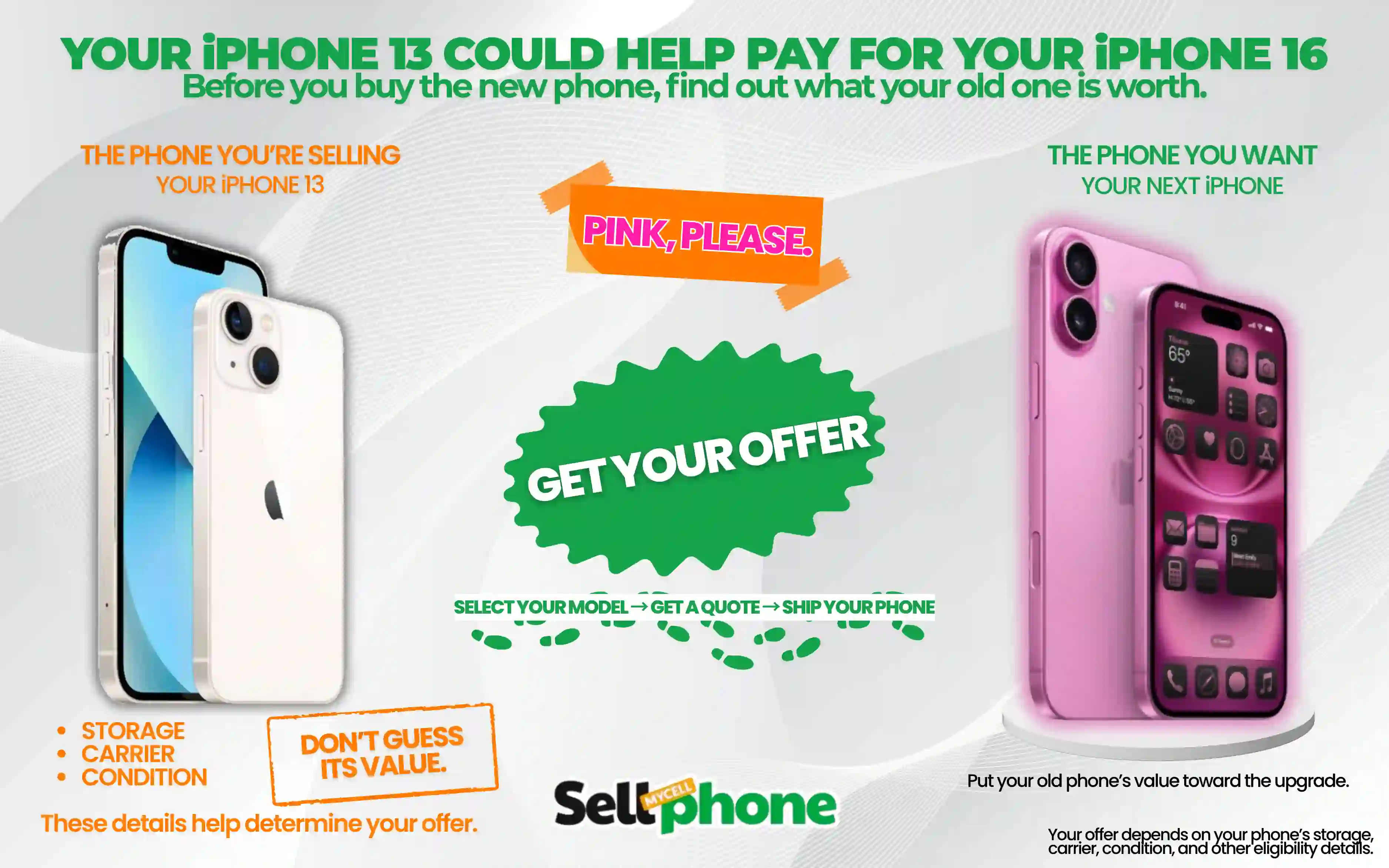
Leaving your iPhone 13 in a drawer is the least useful option. Its value drops a little more with every new iPhone release, so the sooner you act, the more you get back.
Trade-In vs. Selling for cash
Carrier and Apple trade-in programs are convenient, but the value usually comes as store credit or bill credits spread across months, and it often falls short of what the phone is worth. Selling for cash gives you the money up front to spend however you want, including on the iPhone 16 itself.
It is worth comparing offers before you commit. In a side-by-side comparison against major buyback platforms, SellMyCellPhone paid about 30% more on average, which adds up on a phone that still has real resale value.
How to prepare your iPhone 13 for sale
- Back up your data: Use iCloud (Settings > [your name] > iCloud > iCloud Backup) or back up to a computer. If you are moving straight to the iPhone 16, Quick Start can transfer everything directly.
- Unpair your Apple Watch: Open the Watch app and unpair it so it backs up and releases from the phone.
- Sign out of your Apple account: Go to Settings > [your name] > Sign Out. This turns off Find My and Activation Lock. A phone still locked to your account cannot be resold.
- Remove your SIM or transfer your eSIM: Move your number to the new phone before erasing the old one.
- Erase the phone: Go to Settings > General > Transfer or Reset iPhone > Erase All Content and Settings.
- Check the condition honestly: Note any scratches, cracks or battery issues so your quote matches what the buyer receives.
iPhone 13 vs iPhone 16: The bottom line
The iPhone 13 is still a capable phone in 2026. If you're buying on a budget and need something reliable for everyday use, it holds up well. But the iPhone 16 is the better long-term choice, with a sharper and more flexible camera, USB-C, Apple Intelligence support and years more of software updates ahead of it.
If you already own an iPhone 13, the decision comes down to whether those upgrades solve a real problem for you. If they do, your current phone can help cover the cost. Get an instant quote for your iPhone 13 and see what it's worth before its value drops any further.
FAQs on iPhone 13 vs iPhone 16
Is there much difference between an iPhone 13 and 16?
Yes, though not in every area. The screens are almost identical in size and quality, and both run at 60Hz. The real differences are the camera, battery, charging port and software. The iPhone 16 has a 48MP main camera with 2x optical-quality zoom, better battery life, USB-C, twice the RAM, and support for Apple Intelligence, which the iPhone 13 can't run.
Is it worth upgrading an iPhone 13 to 16?
It depends on whether your iPhone 13 is holding you back. If your battery no longer lasts the day, you want a better camera, or you're interested in Apple Intelligence, the upgrade makes sense. If your phone still runs smoothly and the battery holds up, you can comfortably wait. Selling your iPhone 13 can also help offset the cost of the iPhone 16.
Is the iPhone 16 bigger than an iPhone 13?
Barely. Both have a 6.1-inch display, and the iPhone 16 measures 5.81 inches (147.6 mm) tall, 0.31 inch (7.80 mm) deep and weighs 6.00 ounces (170 grams), making it a fraction of a millimeter taller and thicker than the iPhone 13 but slightly lighter. You won't notice it in hand. Cases aren't interchangeable, though, because the camera layout and buttons are different.
Is the iPhone 13 too old for 2026?
No. It still handles everyday tasks well and continues to get major software updates. Apple confirmed at its WWDC 2026 keynote that iOS 27 supports the iPhone 11 and all the same models as iOS 26, which includes the iPhone 13. The main limitations are its aging battery and lack of Apple Intelligence support, not its ability to run current apps. Learn more about iOS 27 support.
Which iPhone is good, 13 or 16?
Both are good, but for different buyers. The iPhone 13 is the better pick if you want a reliable phone at a lower price and your needs are basic. The iPhone 16 is the better choice if you want a stronger camera, longer battery life, USB-C and a phone that will stay supported for more years to come.